
BULLPEN VOLUNTEERS


HOW TO READ A HEAT SHEET
What is a Heat Sheet?
A heat sheet is a "meet program" created for each swim meet that will include all participating swimmers from each competing team, what events they are swimming as well as their heat and lane number. This guide will help you to identify ahead of time what events your swimmer is swimming during the meet and generally when these events will occur.
Heat Sheet facts...
- The heat sheet will always display in the same order for each meet (with the exception of Time Trials) and events are listed #1 through #84. 42 different events are paired for age/gender (ie Event #1 6U Girls Freestyle Relay and Event #2 6U Boys Freestyle Relay).
- Each stroke will have several events specific for age group and gender (ie. Girls 6U 25 yd Backstroke, Boys 6U 25 yd Backstroke, Girls 7-8 25 yd Backstroke, Boys 7-8 25 yd Backstroke, etc). Girls will always swim their events before boys.
- The number of swimmers per heat is determined by how many lanes a pool has. In most pools in our league, 6 can compete per heat. If more than 6 swimmers are entered into an event, there will be multiple "heats" of that event. Heats will be assigned and ordered so that the fastest swimmers will swim in the FIRST heat.
- Lane assignments are typically alternated for home and away athletes (home in 2, 4, 6 - away in 1, 3, 5) with the fastest seeded swimmers in the middle lanes. If there are not equal number of swimmers from each team, they may be swimming next to their own teammates.
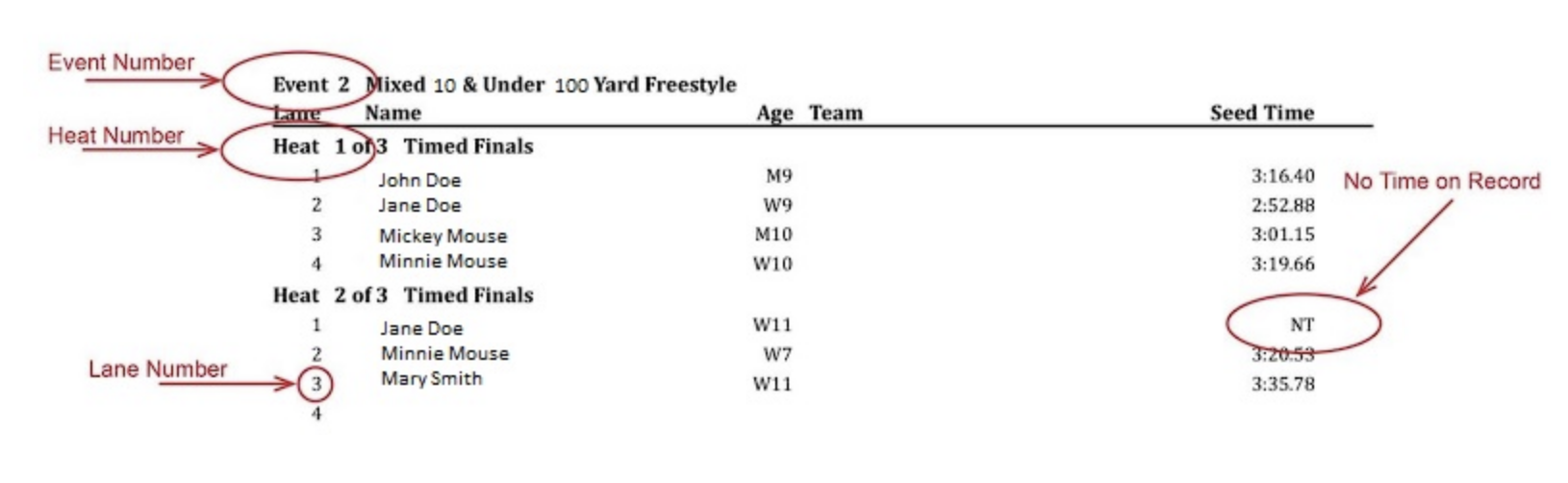
- The "Seed Time" listed on the heat sheet represents a swimmer's previous best time for that event. "NT" indicates that they have "no time" registered to date. Seed times are a good way to see how your swimmer stacks up against the competition but it also serves as a goal. Beating a seed time means establishing a new personal best, regardless of how your swimmer places against the competition.
- Heat sheets cannot be compiled until the visiting team has submitted their entries to the host team. The host team will merge the files and finalize the heat sheet. Once completed, it is forwarded to the visiting team and then posted to the website and sent out as an announcement.
Heat Sheet Diagram for visual learners ;)
HOW TO MARK UP YOUR SWIMMER
Hello FINS Families! Here is one important thing you can do to help your kids have the best summer swim team experience yet. Mark your swimmers with a SHARPIE before you leave the house! Here's a guide:
1. Write your child's first initial and last name, and age on their RIGHT shoulder blade. Example: R. SMITH 11
2. Find the Heat Sheet. These are emailed the day of the meet. Print at home if you like a hard copy--otherwise you can view on your phone.
3. Find your kids' names on the Heat Sheet.
4. Highlight your kids' names on the heat sheet.
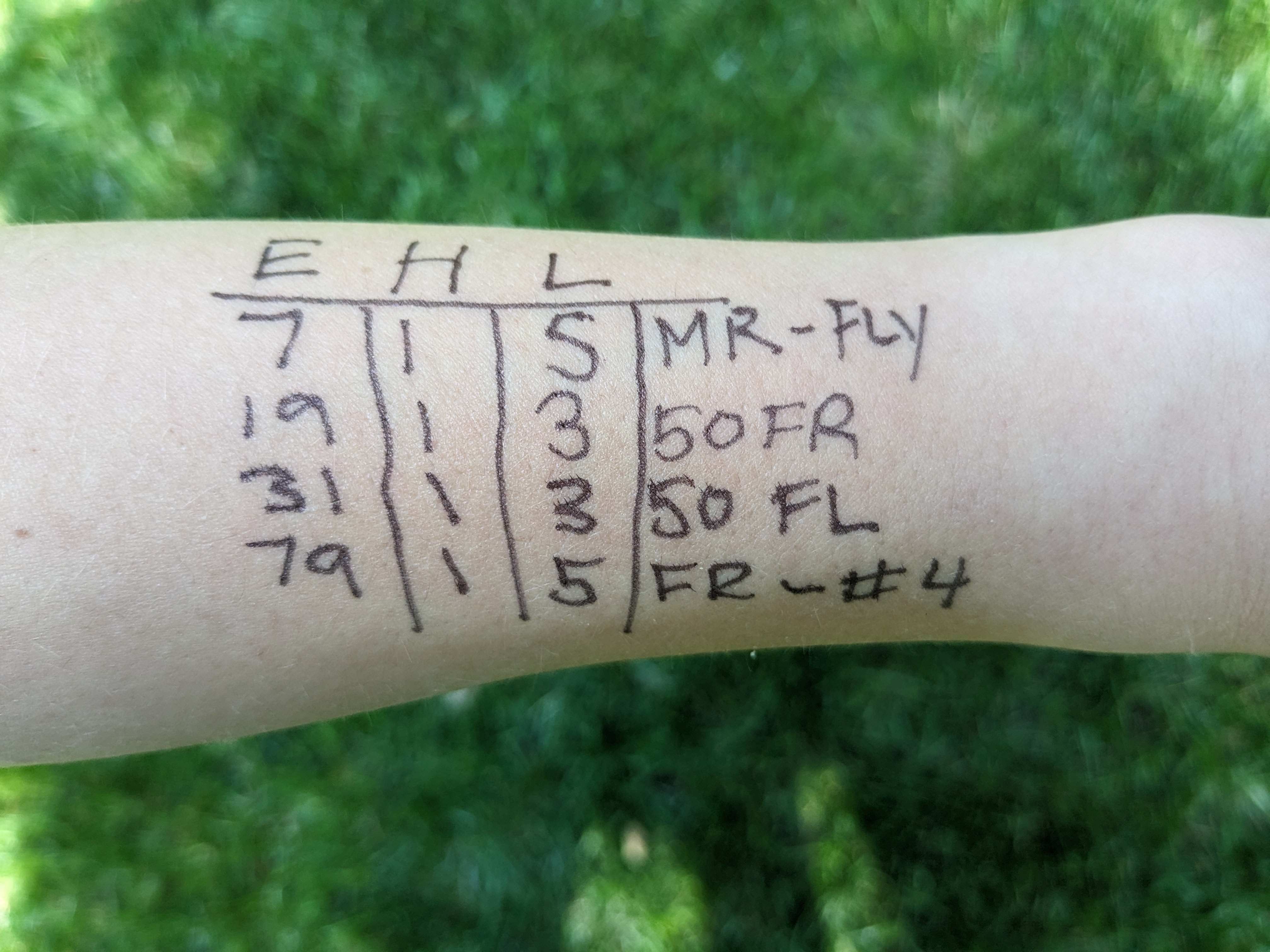
5. Mark your kids' arm or leg with their events. Make sure it is facing towards them, so they can read it! (see photo below for example)
- E - Event #
- H - Heat #
- L - Lane #
- S - Stroke (optional) - you can abbreviate: for example MR = medley relay, FL = Fly, BR = breast, etc.
6. Don't forget relays! it's a SAD time when a relay is missing a swimmer and cannot race.
Medley Relay order (read left to right, top to bottom on heat sheet):
- 1st leg BACK
- 2nd leg BREAST
- 3rd leg FLY
- 4th leg FREE
Freestyle Relay order (read left to right, top to bottom on heat sheet). It can help your child if you mark their position on the relay: for example #4 for final leg.
7. Take a few minutes to explain to your child what the markings on their arm mean. Swim meets can seem chaotic at first, but understanding how they work, even for the kids--helps make it a fun event for all!
8. After the meet you can remove Sharpie markings by applying spray sunscreen and wiping off.
GFSL STROKE & TURN RULES
Backstroke: USA swimming rules will apply with the exception of the turn: - The turn requires that some part of the swimmer's body contact the end wall. After the swimmer's head has passed the backstroke flag, prior to the turn, the swimmer's upper shoulder may (but is not required to) rotate past the vertical toward the breast before the touch is completed, provided such rotation is accompanied by an initiation of the turning action or continuation into the wall.
1. The initiation of the turning action shall be accomplished by a single-arm or simultaneous double-arm pull, or in the absence of such pulls, by an upward or downward, underwater movement of the head.
After the initiation of the turning action, no additional arm pulls may be started; however, kicking and gliding actions are permitted.
The swimmer shall assume a position on the back before the feet leave the wall;
Head catchers: Adults and coaches only are permitted to serve as “head catchers” for swimmers in the 10 and under age groups for backstroke. Hand(s) must be flat against the wall to avoid disqualifying the swimmer.
Relay starts: 2nd, 3rd, 4th leg swimmers must use a track style start, having at least one foot planted on the pool edge at the start of the leg. No walking or running starts allowed.